Oliverland Consulting
People • Fit • Performance
Where Footwear Fit Meets Performance

BETTER CHOICES.
BETTER FIT.
BETTER PERFORMANCE.
“It is even more important to recognise that the most perfect boot, fulfilling all the most stringent conditions of design and construction, is useless if given to the wrong man.”
— Stokes (1960), cited by Dyck
Occupational Footwear Fit Management
Is Footwear Fit an Overlooked Factor in Your Organisation?
Up to 93% improperly fitted
A Canadian Forces footwear-fitting assessment by Dyck found a remarkably high proportion of improperly fitted footwear when both length and width were considered. Up to approximately 93% depending on the fitting criterion/assessment reported—despite the footwear being formally issued within an organisational system.
In Dyck's case, the important point is not merely that several widths were theoretically procured. The distribution of those widths did not correspond adequately to the users' actual needs. If two of the five widths were so narrow that they were effectively unused, the nominal availability of “five widths” gives a misleading impression of fit provision.
The remaining widths then did not adequately cover the population, leading some wearers to compensate for insufficient width by choosing a larger size/length. That, in turn, contributed to the high rate of poorly fitted boots identified in the assessment.
More size options do not necessarily produce better fit if the size and width distribution does not reflect the population being equipped. Poorly matched procurement may also result in underused footwear inventory, adding unnecessary financial burden to the organisation.
.
Frontline Observations from Occupational Footwear Provision
Illustrative comments drawn from professional exchanges and DBA research. Wording has been lightly edited for clarity and anonymity.
“We buy what is available.”
“We collect everyone’s shoe size and send the quantities to purchasing. We get what is available — we don’t really have another choice.”
— Technical Department Manager
Discussion on occupational footwear procurement
Professional exchange, 2026
“I had to wear the issued boots — or take the risk.”
“We had been told that if we wore different footwear and an accident occurred, we might not be covered. I therefore had to wear the issued boots, even though they did not fit me, or accept that risk.”
— Professional respondent
DBA research, 2025
An important and often underestimated issue.
“Your expertise in professional footwear fit and its impact on health, safety and performance addresses an important and often underestimated issue.”
— Police Officer
Professional exchange, 2026
Note: The central quotation reflects the respondent’s understanding and experience. It does not constitute a legal interpretation of the applicable coverage conditions.
How Oliverland Consulting supports organisations
Oliverland Consulting helps organisations improve the occupational-footwear choices available to their employees, while considering footwear-fit needs, operational requirements and budgetary constraints.
Through the Corporate Footwear Fit Program (CFFP), its support connects footwear-fit evaluation, purchasing and procurement decisions, the fitting process and user feedback. This approach aims to promote better-fitting footwear and support employees’ health, safety, well-being and performance, as well as organisational efficiency.
The CFFP therefore transforms footwear fit into a structured and continuous organisational process built around four complementary areas.
Corporate Footwear Fit Program (CFFP)
Better Choices. Better Fit. Better Performance.
The CFFP Organisational Management Loop
CFFP connects footwear policy with fitting practice and wearer feedback, helping organisations move from footwear provision towards continuous footwear-fit management.
Education supports the entire CFFP process. Introduced during Footwear Fit Evaluation, it continues through Procurement, the Fitting Process and Feedback, enabling relevant teams to make and maintain more informed footwear decisions.
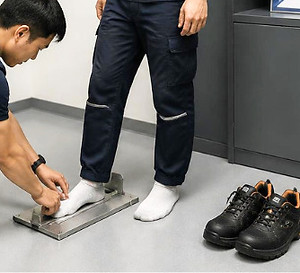
Understanding the current footwear fit of your team
01 — Footwear Fit Evaluation
Evaluate existing or in-use footwear using a structured footwear-fit evaluation method, while building awareness among wearers and relevant organisational teams. Findings are documented in an Organisational Footwear Fit Evaluation Report to help the organisation understand its current fitting status, identify recurring concerns and consider appropriate actions to support more appropriate footwear choices.

Finding more appropriate choices
02 — Procurement
Review footwear needs, current provision and available market options to help identify more appropriate footwear choices within technical requirements, compliance, operational constraints and budget. Findings from the Footwear Fit Evaluation can inform decisions concerning models, sizes, widths, suppliers and the distribution of available options.

Connecting choice to the wearer
03 — Fitting Process
Review the organisation’s existing fitting process and recommend practical actions that may increase the likelihood of achieving a better fit for individual wearers while maintaining a reasonable fitting time. Recommendations are adapted to the footwear options, staff resources and operational constraints of the organisation.

Learning from footwear in use
04 — Feedback
Review the organisation’s existing feedback system and recommend practical actions to better capture wearer experience and fit-related observations. This information can help identify recurring concerns, evaluate footwear acceptance and inform future procurement, fitting-process and footwear decisions.
Start with a 30-minute Discovery Talk
Looking for better occupational footwear choices for your organisation?
The 30-Minute Discovery Talk provides an opportunity to discuss your current footwear provision, the choices available to your employees, and the fit-related challenges you are observing.
We can explore where greater or more appropriate footwear choice may be possible within your operational requirements, procurement constraints and budget, and identify areas that may merit further attention.